A home office does not need to be built like a professional recording studio to provide a better working environment. However, many residential spaces create acoustic challenges that are rarely considered until someone starts working from home every day. Echoes from hard surfaces, conversations from nearby rooms, street noise, and poor microphone placement can all affect concentration and make virtual meetings less clear.
Improving a workspace’s acoustics begins with understanding what type of problem needs to be solved. Some issues come from sound reflecting inside the room, while others involve sound traveling through walls, doors, windows, or ceilings. These situations require different approaches. Sound absorption materials can improve clarity by reducing reflections, while true sound isolation usually requires heavier construction changes and better separation between spaces. The Acoustical Society of America distinguishes these concepts as separate areas of acoustic design rather than interchangeable solutions.
For most remote workers, the goal is not complete silence. A practical home office should create a space where conversations are easier to understand, background distractions are reduced, and microphones capture a cleaner voice signal. With the right combination of furniture adjustments, soft materials, room layout changes, and targeted acoustic improvements, many common problems can be reduced without major renovation.
Before purchasing acoustic panels or changing the room layout, determine where the unwanted sound is coming from. Acoustic problems in home offices usually fall into three categories: outside noise entering the room, sound escaping from the workspace, or poor sound quality caused by reflections inside the room. Each problem requires a different solution, and confusing these categories often leads to wasted time and money.
For example, a person working next to a busy street may have a sound transmission problem involving windows, gaps, and exterior walls. Adding decorative foam panels to the wall may slightly change the room’s internal sound but will not significantly block traffic noise. Similarly, someone whose voice sounds distant and echoing during video meetings may not need construction changes at all. The issue may simply be excessive reflection from bare walls, floors, and furniture surfaces.
A useful first step is to observe the room during normal working hours. Listen for patterns: Are distractions coming from another room? Are they caused by footsteps above? Does the room sound hollow when speaking aloud? Recording a short voice sample on a laptop or phone can also reveal whether the main issue is echo rather than external noise. A clear diagnosis allows improvements to target the actual problem instead of relying on generic acoustic products.
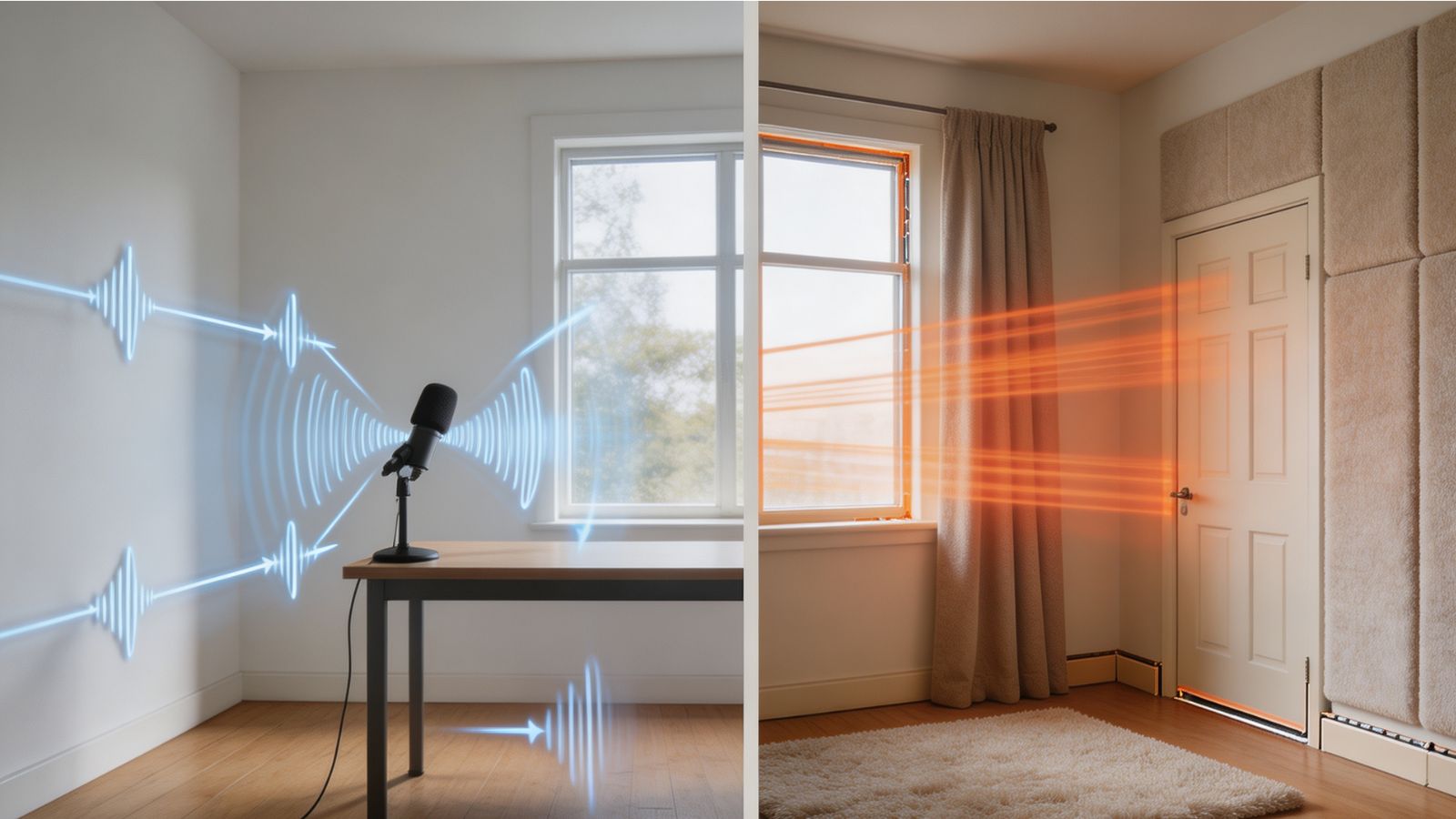
The terms “soundproofing” and “sound treatment” are often used interchangeably, but they address different acoustic goals. Sound treatment improves the way sound behaves inside a room by reducing reflections and controlling reverberation. Soundproofing, more accurately described as sound isolation, focuses on preventing sound from passing between spaces. The materials and construction methods used for each purpose are different.
Sound-absorbing materials are generally soft, porous, or fibrous because they reduce reflected energy when sound enters the material. Common examples include fabric-covered acoustic panels, curtains, carpets, upholstered furniture, and certain ceiling treatments. These materials can make speech clearer by reducing the number of sound reflections reaching a listener or microphone. They are especially useful in rooms with hard surfaces where voices tend to sound sharp, distant, or unnatural.
Sound isolation is more complicated because sound can travel through building structures and small openings. Effective isolation often involves adding mass, improving airtightness, separating structural elements, or upgrading doors and windows. A renter adding removable acoustic panels should not expect the same results as a professionally redesigned wall assembly. Understanding this limitation helps homeowners choose realistic solutions and avoid products that promise more than they can deliver.
Many home offices suffer from excessive reflections because modern rooms often contain large amounts of hard, flat surfaces. Drywall walls, hardwood floors, glass windows, desks, and computer monitors all reflect sound energy. When multiple reflections arrive shortly after the original sound, speech can become less distinct and the room may feel louder than it actually is.
Soft furnishings are often the easiest place to begin. A properly sized rug with a dense pad underneath can reduce floor reflections, while curtains can soften sound reflections from windows. Fabric chairs, bookshelves filled with uneven objects, and upholstered furniture also help break up reflective surfaces. These changes are especially useful for bedrooms or multipurpose rooms that have been converted into offices because they improve acoustics without requiring permanent modifications.
Acoustic panels can provide additional control when basic adjustments are not enough. However, placement matters more than simply covering walls with panels. Panels are most effective when positioned near strong reflection points, such as the areas where sound travels from the speaker toward nearby surfaces and returns to the listener or microphone. A few well-placed panels may provide more benefit than covering an entire room with inexpensive materials.
A high-quality microphone cannot completely overcome a poor room environment. Many remote workers focus on purchasing new equipment while overlooking the acoustic conditions around the microphone. A basic microphone in a well-managed room can often produce clearer results than an expensive microphone placed in a highly reflective space.
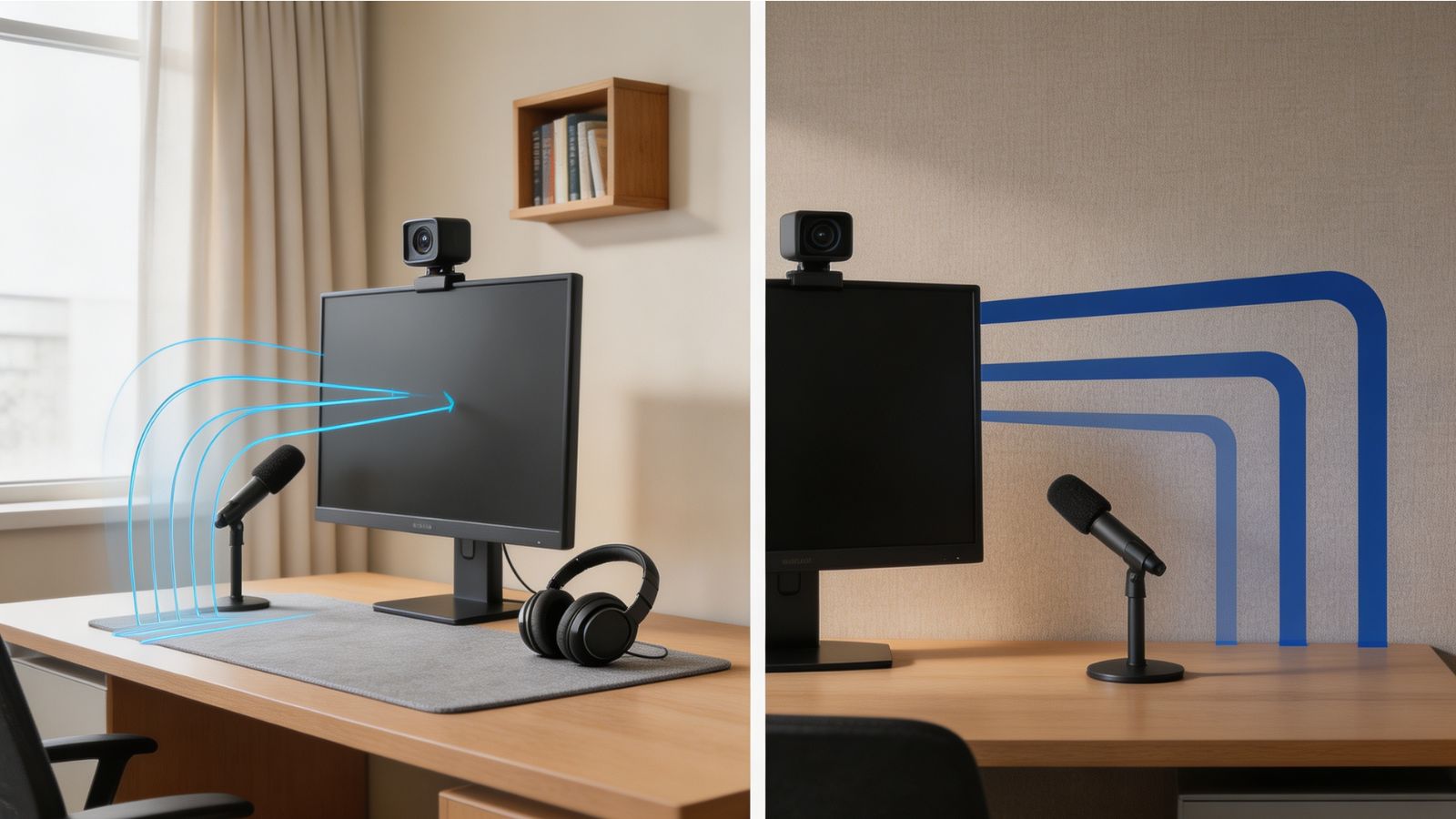
Desk placement plays an important role. A workstation positioned directly against a bare wall may capture more reflected sound than one placed slightly away from reflective surfaces. If possible, position the desk so that the speaker is not surrounded by large empty walls, glass surfaces, or hard corners. Adding soft materials near the speaking area can reduce the amount of reflected sound entering the microphone.
Microphone distance is another important factor. Keeping the microphone closer to the speaker increases the amount of direct voice captured compared with background reflections. Headsets and dedicated microphones can help, but they work best when combined with a reasonably controlled room. Software-based noise reduction can reduce some background sounds, but it cannot fully replace improvements to the physical environment.
Completely soundproofing a home office usually requires construction work, but smaller adjustments can reduce everyday distractions. The first areas to check are doors and windows because small air gaps can allow sound to travel easily between spaces. Weatherstripping around door frames and a door sweep along the bottom edge can reduce leakage through openings.
These adjustments are most effective against airborne sounds traveling through gaps. They will not completely block low-frequency noise such as heavy footsteps, building vibrations, or loud outdoor equipment. Understanding this limitation prevents unrealistic expectations. A sealed door may improve privacy during meetings, but it is not equivalent to rebuilding a wall with professional acoustic materials.
For homeowners planning larger improvements, heavier doors, improved window systems, additional wall layers, or professional acoustic consultation may provide stronger results. These options can be worthwhile when privacy is a priority, such as for people recording content, conducting confidential meetings, or working in noisy households. For many remote workers, however, smaller improvements provide enough benefit without the cost and complexity of structural changes.
The best acoustic solution depends heavily on whether someone owns or rents their home, how much noise they experience, and how much they are willing to modify the space. A renter in an apartment may focus on removable solutions, while a homeowner may consider permanent upgrades.
For a lower budget, simple changes often provide the highest return. A rug, curtains, improved furniture placement, and better microphone positioning can address many common complaints. These adjustments are also flexible because they can move with the user if the workspace changes.
For a medium budget, targeted acoustic panels, upgraded window treatments, and improved office furniture can provide additional control. Higher-budget projects may involve door replacement, construction changes, or professional acoustic evaluation. The important point is to match the solution to the actual problem rather than assuming the most expensive option will always produce the best result.
One of the most common mistakes is assuming that all acoustic products perform the same function. Decorative foam panels may reduce some high-frequency reflections, but they are not designed to block sound passing through walls. Another mistake is adding too much absorption without considering balance. A room with excessive absorption can feel unnatural and may still have unresolved problems with outside noise.
Another frequent issue is ignoring room layout. The location of a desk, microphone, and furniture can influence acoustic performance before any product is purchased. Moving a workstation away from a noisy wall or adding soft materials near reflective surfaces can sometimes create noticeable improvements with little expense.
A successful home office acoustic setup usually comes from combining several reasonable improvements rather than searching for a single perfect product. The objective is a comfortable, functional workspace that supports daily communication and concentration.
Better acoustics can significantly improve a home office, but the right solution depends on identifying the actual source of the problem. Sound treatment helps control echoes and improve clarity inside a room, while sound isolation focuses on reducing sound transfer between spaces. These goals overlap, but they require different approaches.
For most remote workers, the most effective strategy is gradual improvement: reduce reflections with soft materials, optimize desk and microphone placement, address obvious sound leaks, and consider larger upgrades only when necessary. A thoughtfully adjusted workspace can provide clearer calls, fewer distractions, and a more comfortable environment without requiring a complete renovation.
