For decades, cybersecurity experts have repeated the same message: weak passwords remain one of the most common causes of account compromise. People often reuse familiar passwords across multiple services because remembering dozens of unique credentials is difficult. Unfortunately, this habit creates a cascading security problem. A breach involving a small online store, discussion forum, or entertainment website can expose login credentials that attackers later test against email accounts, cloud storage services, financial platforms, and workplace applications. A single compromised password can therefore affect an entire digital ecosystem.
Password managers were developed to reduce this dependence on human memory by shifting credential protection toward cryptographic systems. Modern password managers do much more than store usernames and passwords inside a convenient database. They use layered security architectures that combine client-side encryption, key derivation algorithms, secure synchronization, and increasingly, hardware-backed authentication technologies. Understanding these mechanisms helps explain why password managers have become a central component of contemporary digital security and why their design philosophy continues to influence the future of online authentication.

The defining feature of many modern password managers is their implementation of a zero-knowledge architecture. In simple terms, a zero-knowledge design means that the service provider stores encrypted information without possessing the ability to read it. The company operating the cloud infrastructure does not have direct access to a user's vault contents because the information is encrypted before it leaves the user's device. This architectural decision reduces the risks associated with centralized storage and limits the consequences of server-side data breaches.
Client-side encryption serves as the technical foundation that makes this model possible. When users create, edit, or retrieve credentials, the cryptographic operations occur locally on their computers or mobile devices. The server primarily functions as a synchronization layer that transfers encrypted data between authorized devices. Because encryption occurs before transmission, intercepted or stolen database records typically appear as unreadable ciphertext rather than exposed credentials. This approach does not eliminate every possible attack vector, but it significantly changes the threat model by reducing the amount of sensitive information available to service providers and potential attackers.
The effectiveness of zero-knowledge systems still depends heavily on implementation quality and user behavior. Encryption alone cannot protect users who choose weak master passwords or who store recovery information insecurely. Likewise, software vulnerabilities, compromised endpoints, and phishing attacks remain important concerns. Understanding these limitations is essential because zero-knowledge should be viewed as one layer within a broader security strategy rather than as a guarantee of absolute protection.

Humans create passwords that they can remember, but encryption systems require highly randomized cryptographic keys. Bridging this gap requires an intermediary process known as key derivation. Instead of using the master password directly for encryption, password managers transform it into a mathematically suitable key through specialized algorithms designed to increase computational complexity and improve resistance against brute-force attacks.
A key derivation function, commonly abbreviated as KDF, combines the user's master password with additional randomized data known as a salt. The purpose of the salt is to ensure that identical passwords generate different outputs across different users. This design prevents attackers from using precomputed lookup tables against large collections of stolen credentials. Historically, many applications relied on algorithms such as PBKDF2, but modern password managers increasingly support memory-intensive approaches such as Argon2id, which are specifically designed to make large-scale password-cracking attempts more computationally expensive.
The selection of a strong master password remains critically important even when advanced key derivation methods are used. A sophisticated KDF can slow attackers, but it cannot fully compensate for predictable passwords. Long passphrases built from multiple unrelated words generally provide stronger protection than short, easily guessed passwords. The strength of the entire password management ecosystem ultimately depends on the interaction between human decisions and the cryptographic safeguards implemented by the application.
After the master password is processed through a key derivation function, the resulting cryptographic key is used to protect the contents of the password vault. Many password managers rely on well-established symmetric encryption algorithms, such as AES-256, to secure stored information. Credentials, secure notes, addresses, payment information, and other sensitive records are encrypted locally before being synchronized across devices. This architecture allows users to access their information from multiple platforms without requiring the service provider to maintain an unencrypted copy.
Synchronization introduces additional engineering considerations that extend beyond encryption alone. Modern users expect seamless transitions between desktop computers, smartphones, tablets, and web browsers. To support this experience, password managers must coordinate encrypted databases across multiple environments while preserving data integrity and minimizing synchronization conflicts. Authentication systems are therefore often separated from encryption systems so that account verification and encrypted storage remain distinct processes with different security requirements.
Recovering access after a forgotten password also presents a significant design challenge. Because zero-knowledge architectures intentionally limit the provider's ability to access user data, account recovery options are often more restrictive than those offered by conventional web services. Recovery keys, trusted devices, emergency contacts, and secure backup mechanisms are increasingly incorporated into password manager ecosystems to balance usability with security without undermining the underlying encryption model.
Modern password managers must solve a difficult problem: maintaining strong security while minimizing friction during everyday use. Few users want to type a complex master password every time they unlock an application or visit a website. To improve usability, many password managers integrate with hardware-based security systems built into contemporary operating systems and mobile devices, allowing authentication to occur more efficiently without sacrificing cryptographic protections.
Biometric authentication, including fingerprint recognition and facial recognition, has become one of the most visible examples of this shift. In many implementations, biometric data does not replace the master password itself. Instead, the operating system stores cryptographic material within a protected hardware environment and uses biometric verification as a local unlocking mechanism. This distinction is important because the biometric scan often authorizes access to a key already stored on the device rather than serving as the primary encryption credential.
Convenience features inevitably introduce additional considerations related to device security. A password vault can remain vulnerable if a device lacks a screen lock, runs outdated software, or remains permanently unlocked. Security professionals therefore emphasize a layered approach that includes operating system updates, encrypted storage, short inactivity timeouts, and multi-factor authentication. Strong cryptography remains essential, but the security of the surrounding device ecosystem is equally important in determining overall protection.
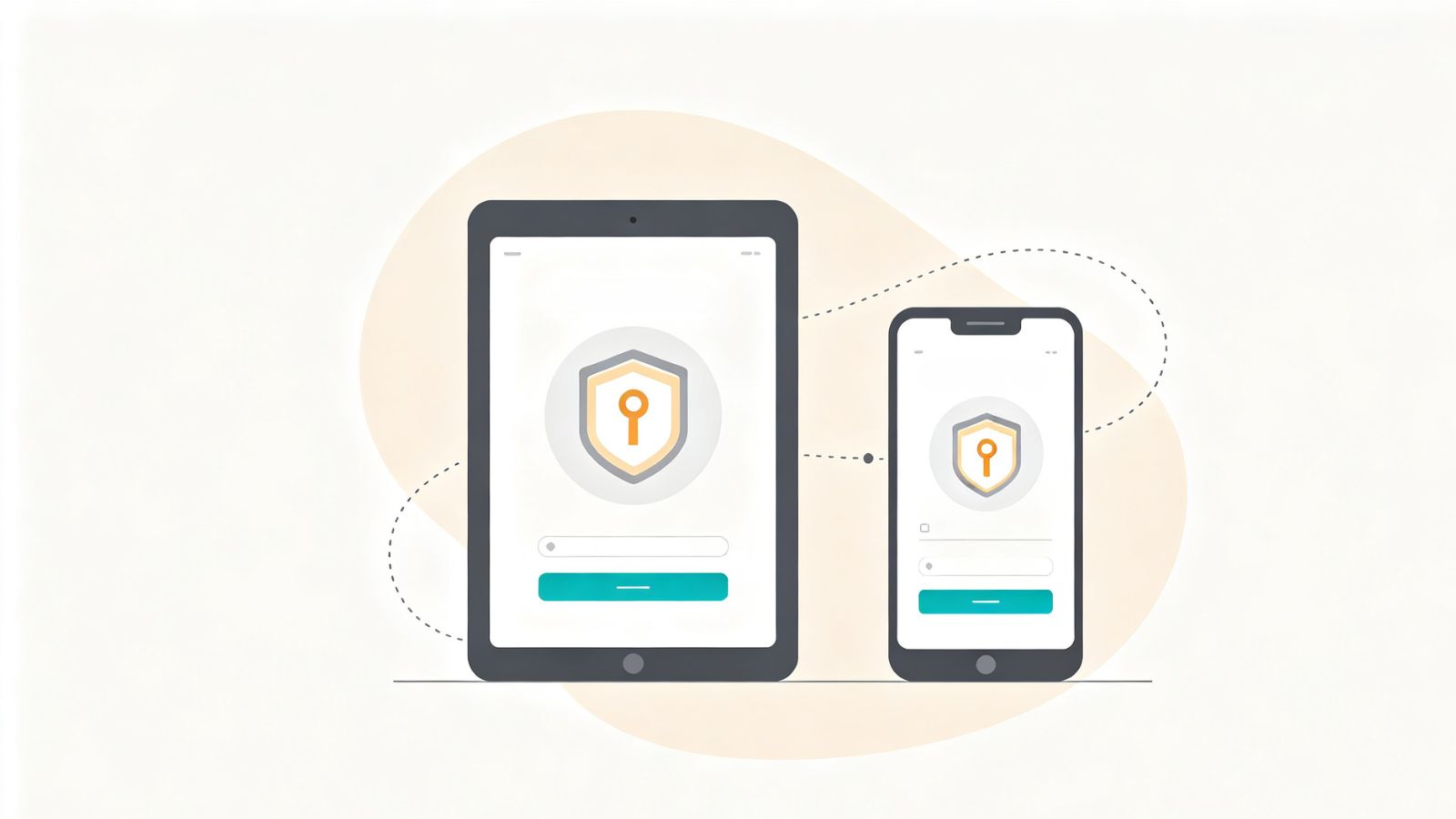
The digital security landscape is gradually moving beyond traditional password-based authentication toward cryptographic credentials commonly known as passkeys. Unlike passwords, which rely on a shared secret known by both the user and the server, passkeys use asymmetric cryptography. The server stores a public key, while the corresponding private key remains securely stored on a trusted device. This architecture changes the authentication process by eliminating the need to transmit a reusable password during login.
Because the authentication mechanism is cryptographically bound to specific devices and domains, passkeys can reduce several common attack techniques associated with traditional credentials. Credential reuse, phishing campaigns, and password database breaches become more difficult because there is no reusable password to steal or replicate. At the same time, passkeys do not eliminate every cybersecurity threat, and their effectiveness still depends on secure device management, account recovery procedures, and ecosystem-wide adoption.
Password managers are adapting to this transition by evolving beyond simple credential storage. Many platforms now support passkey generation, synchronization, and cross-device management alongside traditional passwords. Rather than becoming obsolete, password managers are transforming into broader identity management platforms capable of coordinating multiple authentication technologies within a single secure environment.
Password managers demonstrate how thoughtfully designed cryptographic systems can reduce one of the most persistent weaknesses in cybersecurity: human memory. By combining zero-knowledge principles, client-side encryption, secure key derivation, and hardware-assisted authentication, these systems provide a structured framework for protecting sensitive information across an increasingly fragmented digital landscape. Their value lies not in guaranteeing perfect security, but in reducing the likelihood that a single compromised credential will expose multiple accounts.
The future of digital identity will almost certainly involve a combination of technologies rather than a single universal solution. Passwords, passkeys, biometrics, hardware security modules, and multi-factor authentication will continue to coexist as organizations adapt to evolving threats. Understanding the architectural principles behind these tools helps users make more informed security decisions and encourages a more realistic perspective on how digital identity protection actually works in practice.
